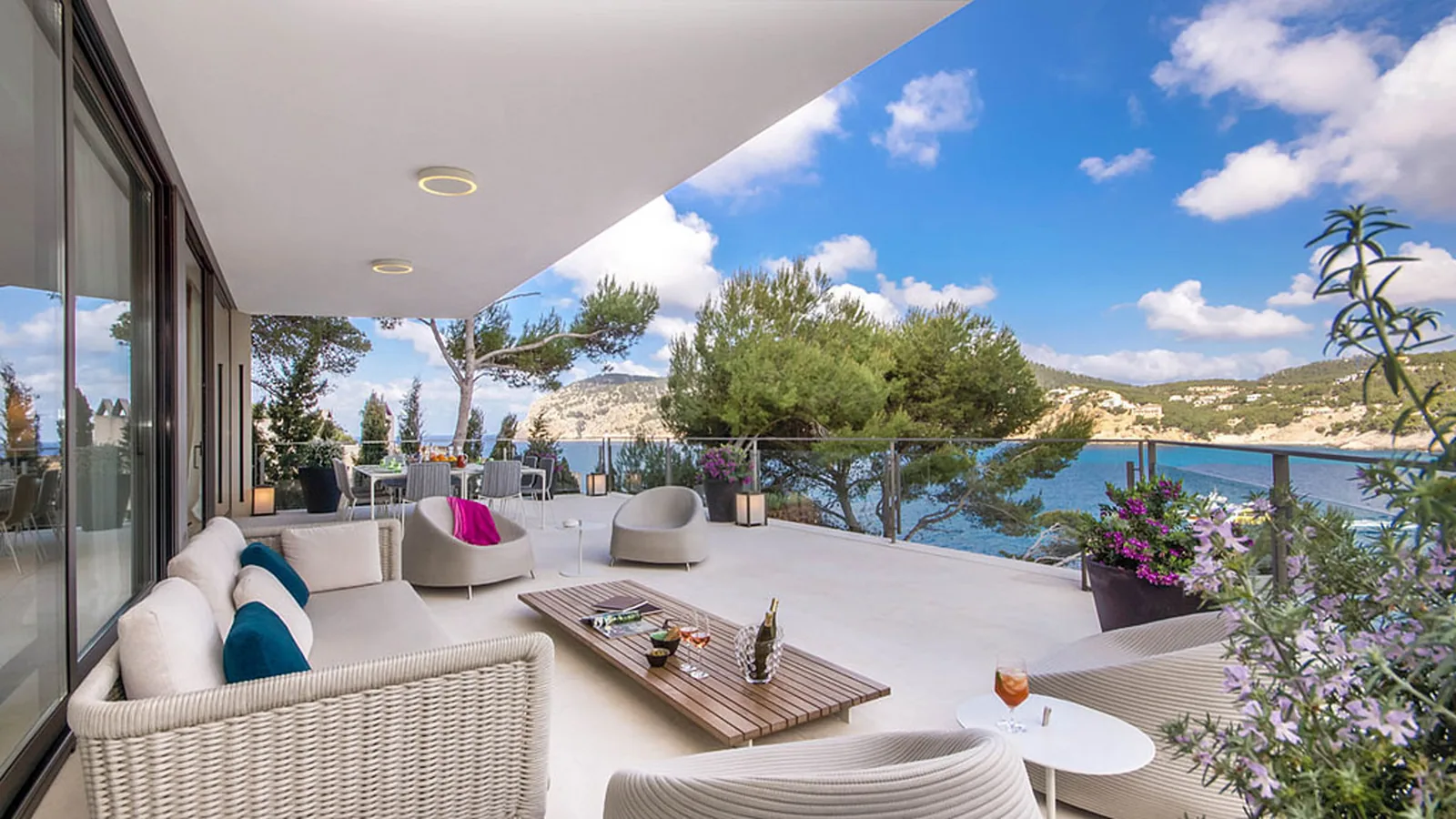
The short answer. In Spain, an existing sea view is generally not a legal right. Neighbouring-window rules protect relations between adjoining owners, not a Mediterranean panorama. A view may benefit from a specific easement, planning height limits or protected land, but each needs documentary checking. Before buying in Mallorca, inspect the sightline from the rooms you will use and investigate every intervening plot.
A photograph tells you what was visible when it was taken. Buying well means understanding why that view exists, what could change it and how much uncertainty you can accept. Start with our sea-view homes for sale in Mallorca, then use this guide to compare the view itself as carefully as the house.
Is a sea view protected by law in Spain?
Not simply because a property has enjoyed it for a long time. Protection depends on the actual title, applicable planning or another specific restriction. These safeguards do different jobs.
What do the Civil Code's luces y vistas rules protect?
The Spanish Civil Code's rules on luces y vistas concern light openings and views over neighbouring land. Under Article 582, windows with direct views, balconies and comparable projections require 2 metres of separation from adjoining land. Lateral or oblique views require 60 centimetres. These distances regulate the relationship between neighbours; they do not reserve an open corridor to the sea.
Direct views are measured from the outer wall face or projection; oblique views from the boundary. The distance rule does not apply to buildings separated by a public road. A compliant balcony is not proof of a protected panorama.
Article 585 addresses an acquired right of direct views over adjoining land. In that situation, the burdened owner may not build within 3 metres, measured under the Code's rules. Even that is not an unlimited height restriction across every plot between your terrace and the water. The relevant provisions are in the Civil Code published by BOE.
Can a deed protect the panorama?
A lawful voluntary easement can impose a specific restriction on another property. For a sea view, the useful question is what the deed actually prevents: building altogether, building above a defined height, or building within a particular envelope.
Ask your lawyer to identify the benefited and burdened parcels, read the full wording and check registration. A restriction on the immediate neighbour may not cover land farther downhill. An ordinary luces y vistas easement is not automatically a panorama easement, and a seller's assurance is not a substitute for the underlying document.
Does Mallorca's coastal protection zone keep the view open?
The general coastal protection strip is 100 metres inland from the inner limit of the ribera del mar, the legally defined shore. It is not measured from today's waterline or from a pin placed on a property photograph.
The frequently quoted 20-metre strip is a transitional rule, notably for land classified as suelo urbano when the Coastal Law entered into force on 29 July 1988, subject to the detailed provisions. Other transitional cases exist. It is incorrect to say that all land classified as urban today automatically has a 20-metre strip.
Within the protection strip, the ordinary rule prohibits buildings intended for residence or habitation. However, authorised uses, exceptions and transitional rules for existing buildings and urban frontages mean that “nothing can ever be built here” is also too broad. Check the official coastal delimitation and affected lines against the parcel, then obtain advice on the applicable regime. The primary source is the Coastal Law published by BOE.
For a front-line home, coastal restrictions may help explain the open foreground. They also require investigation of the property you are buying, not just the land ahead of it. Front-line describes a position; it does not certify permanent view protection or building legality.
Which sea-view type are you actually buying?
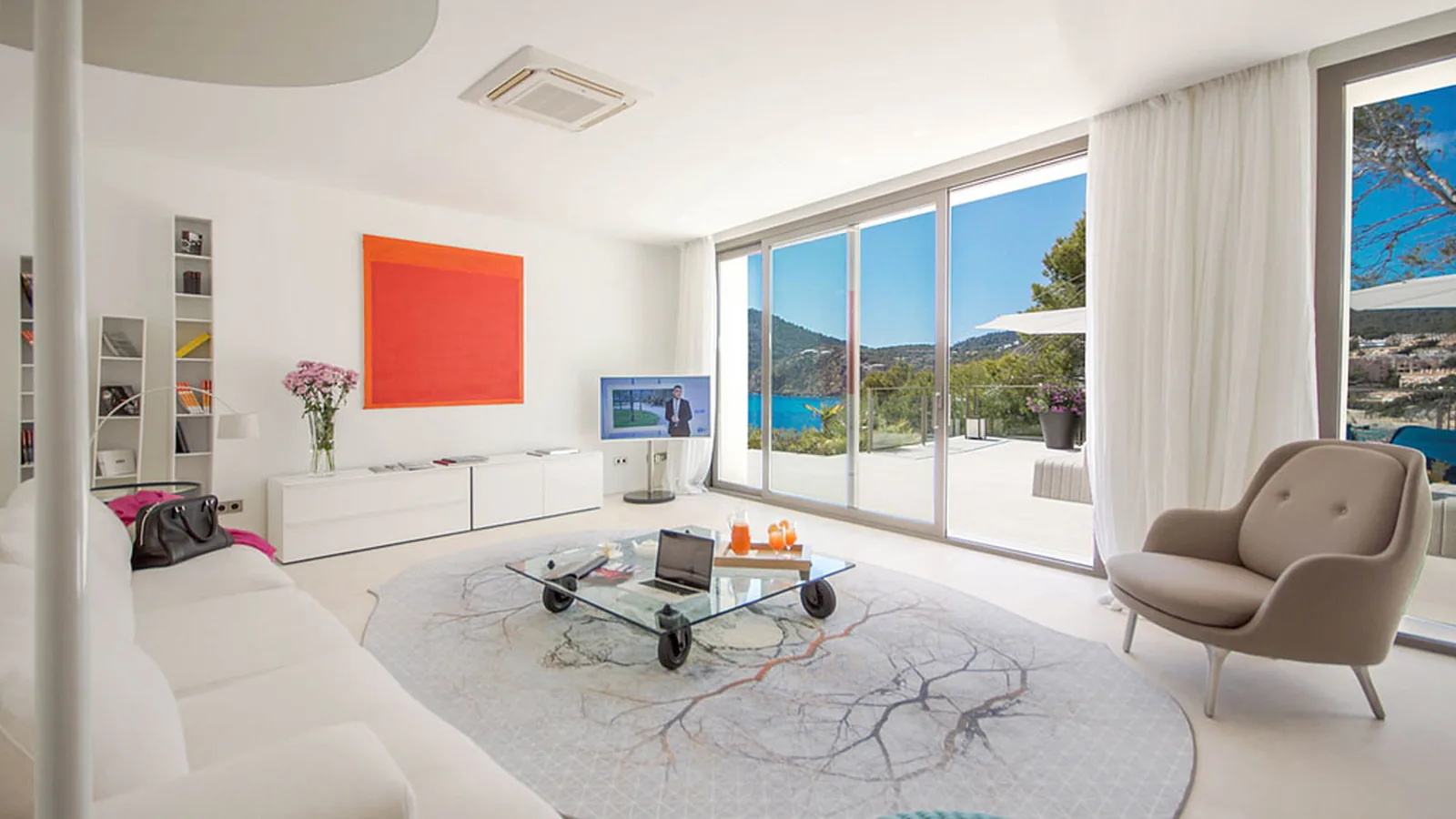
A sea-view villa in Mallorca can offer water directly below a terrace, a distant bay beyond residential roofs, or a panorama visible only from the roof terrace. None is inherently the right choice for everyone. What matters is the view from your normal living position and the evidence behind its durability.
| View type | What can block it | What to check |
|---|---|---|
| Cliffside or front-line | Side-plot development, permitted works in the foreground, growing trees | Coastal lines, adjacent parcels, actual restrictions and the view from each terrace |
| Elevated hillside | Buildings on lower plots, redevelopment, tree canopies | Ground elevations, lawful building envelopes and every plot crossed by the sightline |
| Rooftop panorama | Higher neighbouring roofs or rooftop structures, vegetation | Approved roof plans, adjoining height limits and separate views from the living level |
| Sea view through an urban foreground | Infill building, extensions, changes to intervening roofs | Cadastral boundaries, current planning and neighbouring works files |
These are viewing categories, not legal classifications. Our southwest Mallorca area comparison helps organise locations; only parcel-level checks answer the obstruction question.
What should you check during a viewing?
Sit where you would actually live
Stand at the main window, then sit at the sofa and dining position. Repeat the exercise on the principal terrace, beside the pool and in the bedrooms that matter to you. Note where the sea disappears behind a balustrade, garden planting or neighbouring roof.
Photograph those positions with an ordinary perspective. A roof-level or aerial image can be useful context, but it should not stand in for the view from the living room. If the roof terrace provides the best panorama, decide how often you would use it rather than attributing that outlook to the whole home.
Record floor height and ground elevation separately
An upper floor and an elevated plot are not the same thing. Ask a surveyor or architect to establish the relevant ground levels, finished floor levels and neighbouring building heights where the view is central to the purchase.
Compare the sightline with what could lawfully occupy the intervening land. Could a permitted building envelope rise into the view you value? A neighbourhood-wide altitude or an impression from the road cannot answer that.
Check orientation, light and vegetation
Confirm the direction of the principal windows and terraces. Return at a different time of day to judge glare, shade and how the outlook works indoors. Orientation helps you understand the experience of the view; it does not protect it legally.
Identify the trees and hedges within the sightline, and establish whose land they occupy. Ask about their management rather than assuming the present pruning will continue or that you could remove neighbouring planting. An open building outlook can still depend on vegetation you do not control.
For a focused visit, our guide to planning a Mallorca property viewing trip is a useful companion. Leave time to look beyond the seller's boundary, not just through the house.
Which documents help establish whether the view will last?
Map every intervening plot
Begin with Catastro's property search to identify cadastral references and boundaries. Include the plots below and to either side of the home, especially those crossed by the sightline from the main living area.
Catastro is a starting map. It does not grant a building licence or prove that land is subject to a perpetual view restriction. Compare its description with registry information and the physical survey, then take the identified parcels into the planning review.
Read the adopted planning, not just a coloured map
Palma's municipal planning viewer allows address or cadastral-reference searches across general, detailed and management layers. The council also offers a sectoral-constraints viewer. Calvià's viewer includes cadastral boundaries, land classification and qualification, coastal-law lines and major-work files.
Ask the architect to reconcile the map with the adopted plan and a municipal planning report or certificate. Palma's planning consultation and urban-development certificate records applicable planning, territorial constraints and significant building and use conditions. Use the relevant municipality for homes outside Palma.
Request the permitted metric height, storeys, setbacks, occupation and buildability for each material neighbouring plot. Calvià's planning rules require both limits to be met when height is expressed in metres and storeys. There is no reliable single height figure to apply to every Mallorca sea-view address.
Planning limits can constrain obstruction, but they are not an immutable private view right. Likewise, MUIB, the regional planning map, warns that updating is under way and recent regulatory changes may not be fully reflected. Cross-check it rather than treating an empty or reassuring map layer as conclusive.
Investigate neighbouring licences and protected land
Ask about major-work applications, granted licences and the approved elevations next door or downhill. Distinguish an application from an actual municipal grant, and have the professional team check the grant's validity, conditions and authorised project. A quiet building site or vacant plot does not answer what is permitted there.
Where protection is claimed for rural land or a green area, obtain the exact designation, mapped extent and applicable rules. ANEI means Área Natural de Especial Interés, a protected rural-land category. An official territorial-plan reference to the ANEI of Serra de Na Burguesa does not mean that every nearby residential parcel shares that classification.
The same discipline applies to a listing described as opposite protected greenery: verify which land is protected and whether it lies within the relevant sea sightline. Our property purchase due-diligence checklist covers the wider checks that should accompany this review.
How do the current listings illustrate different views?
These examples explain the questions to ask, not conclusions about legal protection. No parcel-specific easement, neighbouring buildability or permanent panorama protection has been established for them in this guide. The figures below are asking prices, not recorded sale prices.
Cliffside and front-line: Camp de Mar
LUX0018, offered at €15,000,000, is described as a cliffside front-line estate in Camp de Mar with sea and mountain views, an infinity pool and a setting surrounded by pine forest. It illustrates why the immediate foreground, side boundaries and vegetation all deserve attention, even where the sea is visually close.
Inspect the actual outlook from the living spaces and terraces, then check the coastal lines and adjoining land. The listing's description of uninterrupted views is a description of the outlook, not proof of a permanent legal right.
Elevated villas: Sa Font Seca and Costa den Blanes
LUX0020, at €6,800,000, is the villa in Sa Font Seca, Bunyola, described as south-facing with views over the Bay of Palma. It is an example of a bay outlook rather than a front-line position. Confirm orientation and the view from the main living and pool level, then investigate the land crossed by that outlook.
LUX0049, at €4,500,000, is described as elevated above the coastline in Costa den Blanes, with sea views and a principal suite with private terrace access. Compare that terrace's view with the main living areas and garden; elevation alone does not remove obstruction risk.
Rooftop views: Santa Ponsa and Cala Major
LUX0035, offered at €4,200,000, is the Santa Ponsa villa whose description says it is undergoing a complete high-end renovation. Its private rooftop terrace has open sea views, and the property is described as opposite a protected green area. Verify that protection independently and avoid reading the rooftop outlook as a promise about the ground-floor view.
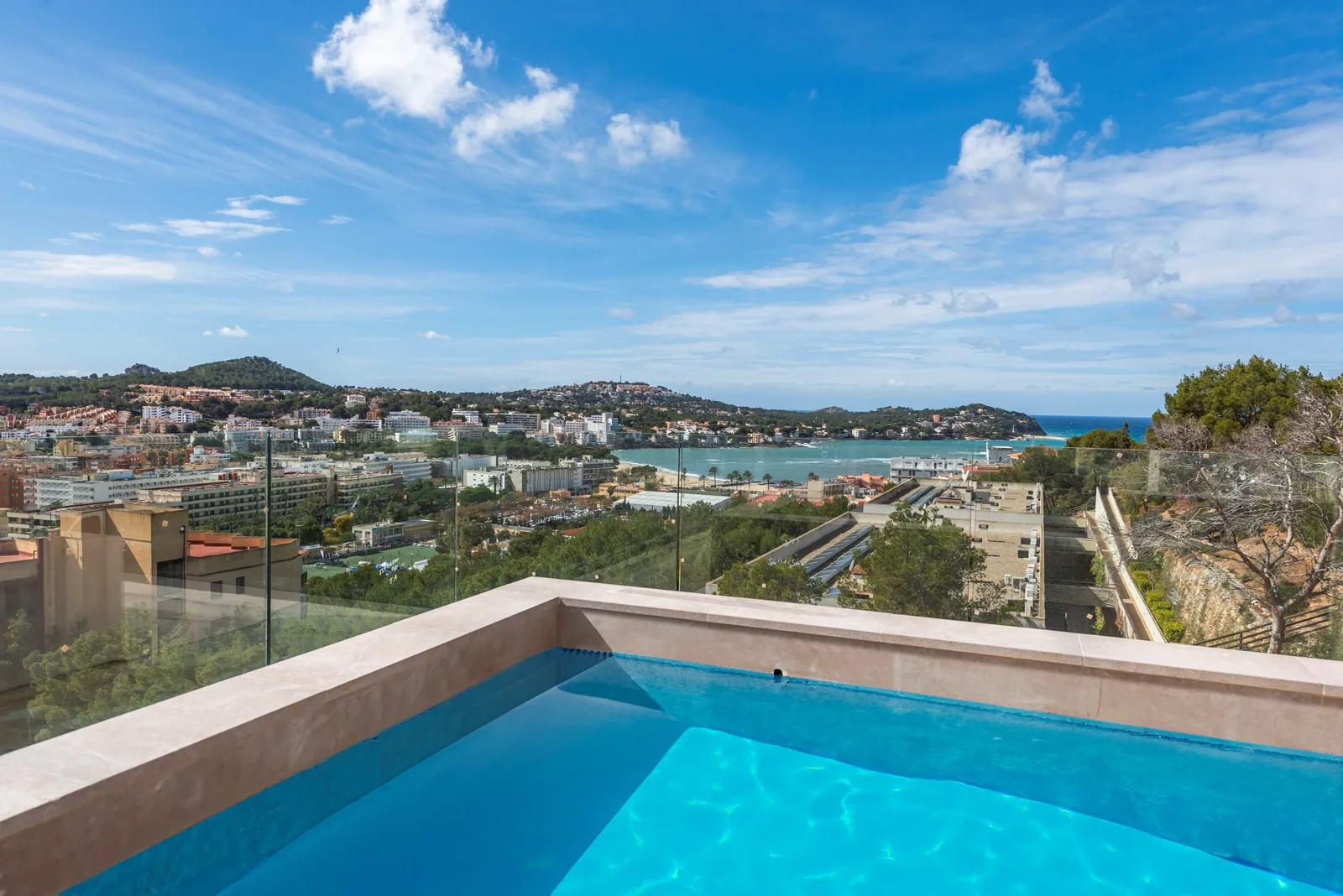
ATC0018, at €2,992,500, is an elevated Santa Ponsa penthouse with sea views from covered terraces and a private roof terrace with its own swimming pool. Compare the living-level and rooftop outlooks.
ATC0019, at €1,590,000, is the Cala Major property described as having approximately 112 m² of interior space and a private rooftop terrace of approximately 80 m² with wide sea views. Its balcony also has views towards the Mediterranean and the green hills of Genova. This is a useful reminder to assess the balcony and rooftop separately.
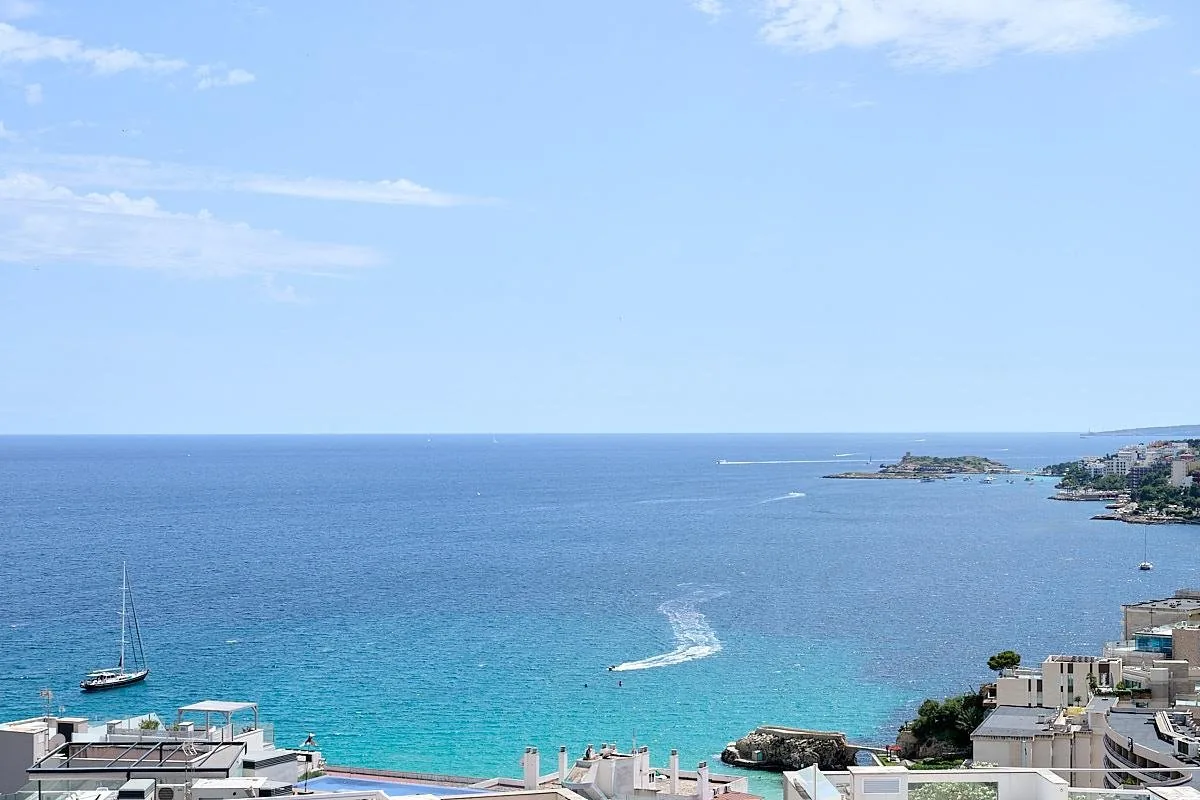
ATC0020, offered at €4,000,000, is a Cala Major penthouse listing within the JANIA new development. The development description distinguishes sea-view first-floor homes from penthouses with roof solariums and panoramic Mediterranean views; completion is scheduled for the end of 2028. Treat the proposed outlook as something to test against the authorised design and neighbouring planning, not as an already inspected finished view. Our off-plan buying guide explains the wider distinction.
What should be checked before you pay a binding deposit?
Use this practical checklist with an independent lawyer and an architect or surveyor:
- Define the important view. Record the rooms, terraces and seated positions from which it matters to you.
- Document the sightline. Retain representative photographs and identify the intervening parcels.
- Measure the levels. Check ground elevation, finished floor height and the relevant neighbouring building envelope.
- Obtain current planning evidence. Confirm classification, detailed height rules, setbacks and any protected-land or coastal constraints.
- Review neighbouring works. Check applications, granted licences and authorised elevations where relevant.
- Read any claimed easement. Establish the precise restriction, affected land and registration position.
- Assess vegetation. Identify ownership and avoid relying on future pruning that has not been established.
- Resolve material uncertainty before committing. Ask your lawyer how unresolved view-related matters should be handled in the contract.
The aim is an informed decision: a view you have experienced, planning you understand and no undocumented assumption carrying the purchase.
Browse the current sea-view property collection, set email property alerts, or contact a Balearic Blue adviser with the rooms and outlook you want prioritised. Keep this review alongside the wider Mallorca buying guide.
Is a sea view a protected legal right in Spain?
An existing panorama is generally not protected simply because it is visible today. Meaningful protection depends on a specific easement or title restriction, applicable planning or another relevant legal constraint.
Do luces y vistas rules stop a neighbour blocking my sea view?
Not generally. The Civil Code's adjoining-property distances regulate windows, balconies and neighbouring views; they do not guarantee an uninterrupted panorama to the sea.
Is the coastal protection zone always 20 metres on urban land?
No: the general strip is 100 metres inland from the inner limit of the legally defined shore. The 20-metre rule is transitional, notably for land classified as urban when the Coastal Law entered into force on 29 July 1988, and its application must be checked for the parcel.
Does an elevated villa or penthouse have a safer view?
Elevation is a reason to examine the ground levels and neighbouring building envelopes, not proof of legal protection. Check the outlook from the living level separately from a roof terrace and account for intervening vegetation.
Can a planning map prove that land in front cannot be built on?
A viewer is useful for identifying parcels and planning layers, but it should be reconciled with adopted planning and municipal evidence. Also investigate any relevant works licences and the actual wording of claimed title restrictions.
Sources checked on 10 November 2026: BOE (Civil Code, Coastal Law, Mortgage Law, Catastro Act and Balearic urban-planning legislation); Ajuntament de Palma (planning procedures and viewers); Ajuntament de Calvià (planning rules and viewer); Dirección General del Catastro; Govern de les Illes Balears/ICGIB (MUIB and IDEIB); Consell de Mallorca (territorial-plan reference to protected rural land); and Balearic Blue's current listings. This article is general information, not legal or tax advice. Obtain independent legal and technical advice on the identified property and neighbouring parcels before committing.