
The short answer. When you buy a resale home in Mallorca, you pay the Balearic property transfer tax (ITP) on a progressive scale: 8% up to €400,000, rising in bands to 13% above €2 million. On a €2.6 million purchase, which is the median asking price across our current portfolio, the tax comes to €288,000, an effective rate of 11.08%. A new home bought directly from the developer pays 10% VAT (IVA) plus 1.5% stamp duty (AJD), or 2% when the price is €1 million or more. Notary, land registry and legal fees are added to either figure.
This guide sets out the rates in force on 5 October 2026, checked against the Balearic Tax Agency (ATIB), the State Tax Agency (AEAT) and the Official State Gazette (BOE). It works them through at the prices our buyers actually pay and explains the deadlines and cash movements that determine when the money leaves your account. Several widely read guides still quote an 8–11% scale or a 1.2% stamp duty. Neither has been correct for purchases at this level for some time.
Resale homes: how the Balearic ITP scale works
ITP (Impuesto sobre Transmisiones Patrimoniales) applies to second-hand homes, whether bought from a private individual or from a company that is not making a first delivery. The Balearic scale is progressive. Each band of the price is taxed at its own rate, so the 13% rate applies only to the part of the price above €2 million, never to the whole amount.
| Portion of the price | Rate | Tax on the full band |
|---|---|---|
| Up to €400,000 | 8% | €32,000 |
| €400,000.01 to €600,000 | 9% | €18,000 |
| €600,000.01 to €1,000,000 | 10% | €40,000 |
| €1,000,000.01 to €2,000,000 | 12% | €120,000 |
| Above €2,000,000 | 13% | on the excess |
Source: ATIB, general ITP rates for real estate, checked 5 October 2026.
Worked example at €2.6 million: €32,000 + €18,000 + €40,000 + €120,000 + 13% of the remaining €600,000 (€78,000) = €288,000.
Purchase tax at Mallorca's prime price points
| Purchase price | Resale: ITP | Effective rate | New build: IVA 10% + AJD | Effective rate |
|---|---|---|---|---|
| €700,000 | €60,000 | 8.57% | €80,500 | 11.50% |
| €1,000,000 | €90,000 | 9.00% | €120,000 | 12.00% |
| €1,500,000 | €150,000 | 10.00% | €180,000 | 12.00% |
| €2,600,000 | €288,000 | 11.08% | €312,000 | 12.00% |
| €5,000,000 | €600,000 | 12.00% | €600,000 | 12.00% |
| €10,000,000 | €1,250,000 | 12.50% | €1,200,000 | 12.00% |
| €15,000,000 | €1,900,000 | 12.67% | €1,800,000 | 12.00% |
The table shows something most guides miss. Below €5 million a new build costs more in tax than a resale home at the same price. Above €5 million the position reverses, because the progressive ITP scale keeps climbing towards 13% while new-build tax stays flat at 12%. At €15 million the gap is €100,000, which is a material factor when you are choosing between a finished new estate and an established one.
New builds: VAT plus stamp duty
The first delivery of a completed home by the developer is subject to VAT rather than ITP. For homes the rate is generally 10%. The notarial deed then also attracts stamp duty (Actos Jurídicos Documentados, AJD). In the Balearics AJD is 1.5%, rising to 2% for deeds transferring property worth €1 million or more (ATIB, AJD rates; AEAT, VAT or ITP on a home purchase).
"New" is a legal status, not a description. A home that has just been fully renovated is not automatically a VAT transaction. Nor is a recently completed villa that has already been sold once or lived in. Ask your lawyer to confirm the tax status in writing before you sign the private contract, because it changes the bill. At €2.6 million the difference is €24,000.

The tax base is not always the price you agree
For ITP, the taxable base is at least the Catastro reference value (valor de referencia), even if the price you agree is lower. The reference value is published for each property by the Directorate General for the Cadastre (Catastro) and can be checked in its electronic office. It is not the same as the cadastral value used for annual IBI property tax. In prime Mallorca agreed prices are usually above the reference value, but check it before you budget, especially for rural land, plots and properties needing renovation.
Professional fees
- Notary. The notary's fee follows a regulated scale (arancel) that declines as a share of the price. On a high-value purchase it is a small fraction of the tax bill. Under the Civil Code the seller pays for executing the deed and the buyer pays for the first copy, unless the contract says otherwise (Civil Code, Article 1455). Many contracts assign all notary costs to the buyer, so read that clause.
- Land registry. Registration is also charged on a regulated scale. The deed should be registered promptly, because registration is what protects you against third parties (Spanish government guide to notaries and land registries).
- Independent lawyer. Fees are not regulated. Agree a written scope and fee before instructing anyone, and make sure the lawyer acts only for you.
- Mortgage, if you use one. Under Spain's 2019 mortgage law you pay the bank's valuation. The lender pays the notary for the mortgage deed, the processing agency (gestoría) and the registration of the mortgage (Law 5/2019, Article 14). Our mortgage page explains how non-resident lending works.
Deadlines and the cash timeline
The tax is only one of several payments, and they fall at different times. A typical resale purchase in Mallorca runs like this.
- Reservation. Some sellers ask for a small reservation payment to take the property off the market while your lawyer checks it. Make sure the agreement says whether it is refundable.
- Due diligence before any binding deposit. Your lawyer obtains the land registry extract (nota simple) to confirm ownership, mortgages, charges and restrictions, and checks the Catastro record, building permits, licences, IBI and community-fee arrears.
- Private contract and deposit. The private purchase contract usually takes the form of an arras contract, with a deposit commonly around 10% of the price. Under penitential arras, a buyer who withdraws loses the deposit and a seller who withdraws returns it doubled.
- Completion before a notary. The balance is paid when the public deed (escritura) is signed. You need a Spanish foreigner's tax identification number (NIE) before this point. It can be requested in Spain, through a Spanish consulate or by an authorised representative (Spanish Consulate, NIE). An NIE identifies you for tax purposes. It does not give you residence.
- Tax return within one month. ITP, or AJD on a new build, is declared and paid with ATIB form 600 within one month of the deed (ATIB form 600 instructions). In practice your lawyer or the notary's processing agency files it immediately after completion, which is why most buyers deposit the tax and fees with them on completion day.
- Registration. Once the tax is paid, the deed is presented to the land registry.
When the seller is not resident in Spain
If the seller is a non-resident individual or company, you must withhold 3% of the price and pay it to the State Tax Agency on form 211 within one month. The withholding is an advance payment towards the seller's tax (AEAT, transfers by non-residents). It comes out of the price rather than adding to your cost. On a €2.6 million purchase it is €78,000. Separately, the buyer becomes legally responsible for the municipal land value tax (plusvalía) when the seller is a non-resident individual (Local Treasury Law, Article 106). Your lawyer will normally retain the estimated amount from the price at completion. Both points must be in the contract.

What changed in 2026, and what did not
- Law 4/2026 (in force 14 June 2026) revised Balearic reliefs for primary residences. For Mallorca and Menorca the main-home value threshold is now €331,859.70 (ATIB notice). These reliefs depend on personal conditions and rarely apply to purchases in our price range. The general scale above has not changed.
- The investor "Golden Visa" has gone. Buying property no longer gives access to residence. The route closed for new applications on 3 April 2025 under Organic Law 1/2025. Anyone moving to Mallorca needs a separate residence route, which our fiscal advisory team can explain.
- The proposed 100% tax on non-EU buyers is a proposal, not law. It was announced in January 2025 and had stalled in parliament by March 2026 (Reuters, March 2026). It was not part of the housing decree-laws that Congress rejected on 2 October 2026 and has never been published in the BOE (El Periódico, 2 October 2026). A general election has since been called for 29 November 2026 (Reuters via CBC, 5 October 2026), so the next government's housing programme matters more than past announcements. Check the position again before signing.
Five checks before you pay a deposit
- Get a written estimate of tax and fees on the agreed price, based on the correct legal status (resale or first delivery).
- Check the Catastro reference value and the land registry extract.
- Ask whether the seller is tax-resident in Spain, so the 3% withholding and plusvalía can be written into the contract.
- Confirm how the funds will be transferred and what evidence of their origin your bank and the notary will need.
- Model your annual costs too: IBI, waste collection, community fees, insurance and, for non-residents, the annual imputed-income return. Our guide to non-resident tax obligations covers them.
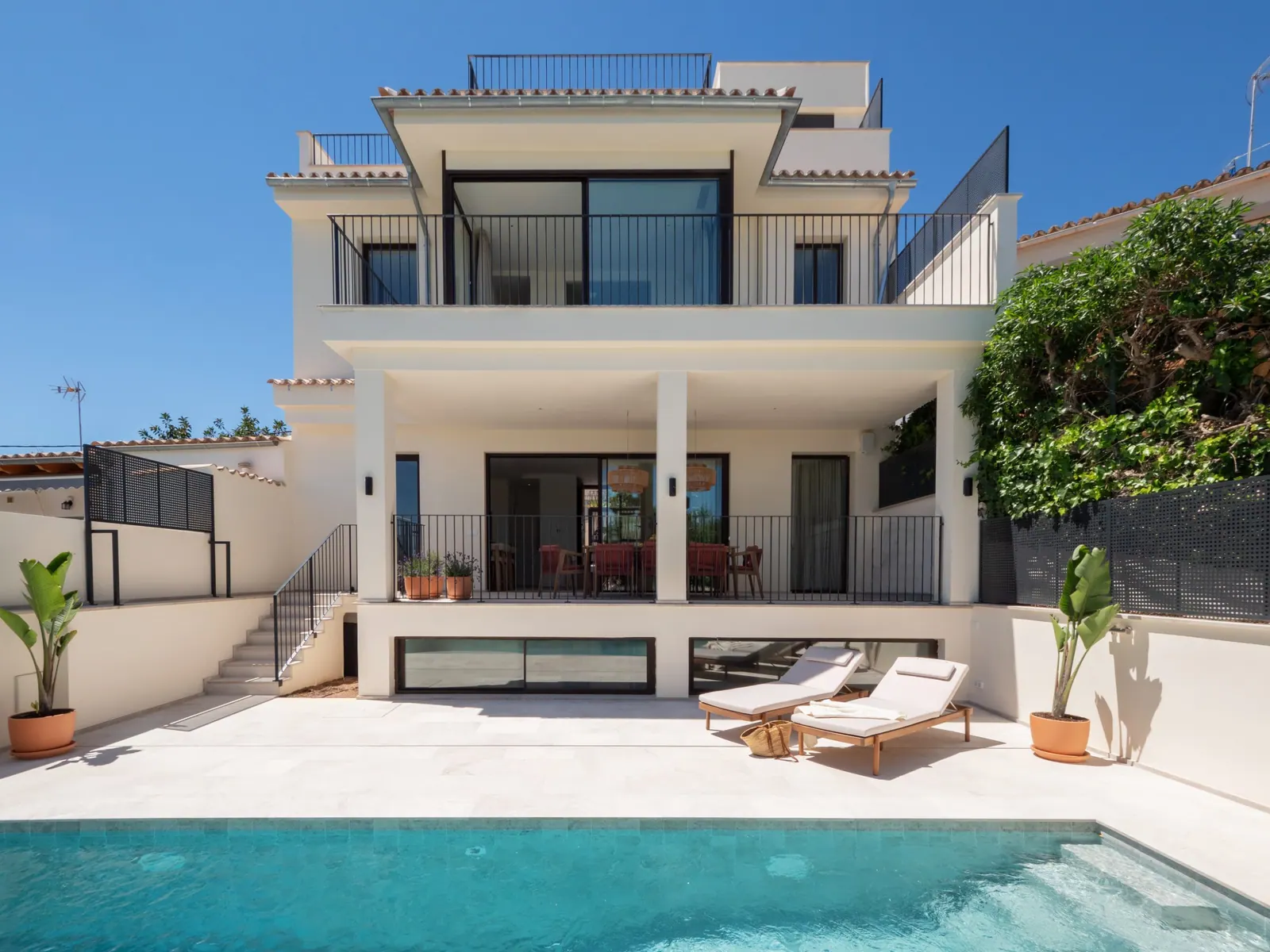
The homes above illustrate the examples in this guide. You can browse more villas for sale in Palma or the full property catalogue. For a cost estimate on a specific home, contact us and we will prepare one with an independent lawyer.
How much is property transfer tax in Mallorca in 2026?
For resale homes the Balearic ITP is progressive. The rates are 8% up to €400,000, 9% to €600,000, 10% to €1 million, 12% to €2 million and 13% above €2 million, each applied only to its own band. A €1 million purchase pays €90,000 and a €2.6 million purchase pays €288,000.
Do I pay ITP on a new-build villa?
Not if you buy it from the developer as the first delivery. In that case you pay 10% VAT plus AJD stamp duty of 1.5%, or 2% for deeds of €1 million or more. Later sales of the same home are resales and pay ITP.
How long do I have to pay the purchase tax?
One month from the date of the deed, using ATIB form 600. In practice the lawyer or the notary's agency files it straight after completion.
What is the 3% retention when buying from a non-resident?
When the seller is not tax-resident in Spain, the buyer withholds 3% of the price and pays it to the State Tax Agency on form 211 within one month, as an advance on the seller's tax. It is deducted from the price paid to the seller, so it is not an extra cost for the buyer.
Does buying property in Mallorca still give residency?
No. The property-investment Golden Visa closed for new applications on 3 April 2025. Owning a home in Mallorca does not give you the right to reside. A separate residence route is needed.
Sources checked on 5 October 2026: ATIB (ITP and AJD rates, form 600), AEAT (VAT or ITP, form 211), Catastro (reference value), BOE (Organic Law 1/2025, Law 5/2019, Local Treasury Law, Civil Code) and the Spanish government's guide to notaries and land registries. This article is general information, not tax or legal advice. Rates and reliefs depend on the transaction and your personal circumstances, so obtain independent professional advice before you commit.